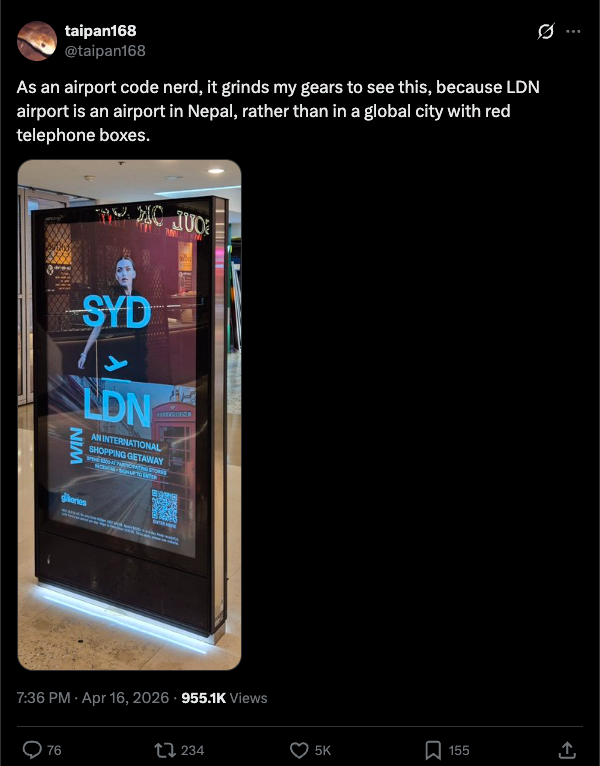
I came across this post on X the other day and it made me laugh out loud. The ad showed a sleek digital screen at what looked like a busy airport, promoting a trip from SYD to LDN. A woman in a stylish pose, and the promise of winning a shopping getaway. The only problem? LDN is not London. It is a small airport in Nepal.
That mix-up got me thinking about airport codes in general. They are those three-letter tags we see on boarding passes and departure boards. Most of us barely notice them until something odd jumps out. But once you start looking, you realise how many are strange, funny or just plain confusing.
These codes come from a standard list kept by the International Air Transport Association. Airlines and airports use them to avoid mix-ups in computer systems. Yet the choices often feel random or tied to old names that no longer fit.
Take LOL, for example. It belongs to a quiet airfield in Lovelock, Nevada. Picture telling someone you are flying into LOL. It is hard not to smile. Then there is OMG in Namibia. Yes, that is a real airport code. BOO serves Bodo in Norway, perfect for a spooky autumn visit. And BRR covers Barra in Scotland, where the runway is a beach and the wind can make you shiver for real.
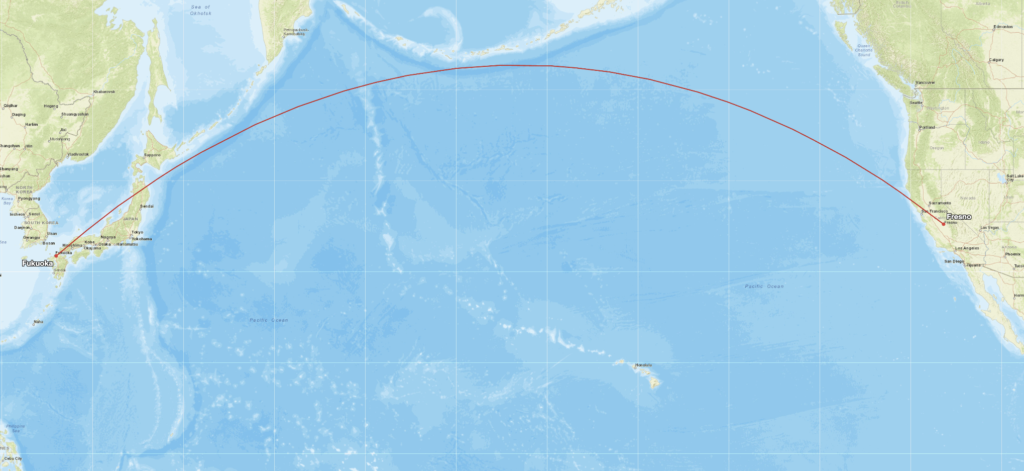
Some codes feel like they were picked as a joke. SUX in Sioux City, Iowa, has locals selling T-shirts that say “Fly SUX” with pride. POO is in Brazil, at Poços de Caldas. FUK is the code for Fukuoka in Japan, and it still raises eyebrows at check-in desks worldwide. FAT leads to Fresno in California, while BUM marks a small airport in Missouri. You could not make this up.
Even major cities have quirks. London uses LHR for Heathrow and LGW for Gatwick. No wonder the ad designers reached for LDN instead. It sounds modern and simple, like a text message shorthand. But the real LDN sits in the hills of Nepal, far from red telephone boxes and black cabs.
Other codes tell little stories from the past. OGG in Maui honours a local pilot named Charles Hogg. ORD in Chicago comes from its old name, Orchard Field. HEL is Helsinki, which always sounds a bit dramatic. And then there is the simple pleasure of spotting GRR for Grand Rapids or CAT in Portugal.
These odd codes turn routine travel into something more human. You spot one on your ticket, mention it to the person next to you, and suddenly you have a conversation starter. They remind us that flying is not always slick and corporate. It has personality, history and the occasional silly moment.
Next time you are at the gate or killing time in the lounge, check the departure board. You might see something that makes you do a double take.